Why Lukashenko avoids attacking Zelensky while Belarusian propaganda doesn't

The new conditions of the war are forcing the Belarusian regime to change its rhetoric / euroradio.fm
In recent months, the Belarusian regime has been facing informational pressure from Ukrainian authorities that would have seemed impossible not long ago. It is already bearing fruit — the rhetoric of state propaganda and official figures has diverged noticeably.
While propagandists heap abuse on Ukrainian President Volodymyr Zelensky, Alexander Lukashenko and Belarusian officials speak in considerably more restrained terms.
Euroradio compared how the authorities and state media reacted to two incidents involving the shelling of civilian buses on June 17 and July 2, and media expert Paulyuk Bykouski explained what this means.
Some are hurling insults, others are urging against hasty conclusions
The attack on a bus carrying Belarusian children in the Bryansk region on June 17, which killed the wife of a football coach, Viktoria Haroshka, divided the information space within Belarus.
Belarusian diplomats immediately responded to the incident in the language of international law. The event was described as an "act of terrorism" and a violation of international humanitarian law norms. The Belarusian Ministry of Foreign Affairs summoned Ukraine's chargé d'affaires, demanding explanations and an investigation, while Belarus's permanent representatives to the UN, Valentin Rybakov and Larisa Belskaya, used international platforms to accuse Kyiv of deliberate violence.
At the same time, Rybakov stressed that Minsk, despite the incident, continues to advocate for a diplomatic settlement and the negotiation process.
State Security Council Secretary Alexander Volfovich took a more pragmatic and restrained stance. He stated that the incident was likely unintentional and drew attention to safety issues in the organisation of the trip.
Lukashenko himself only responded to the tragedy on June 18 and was equally restrained in his remarks. He called the attack a manifestation of open fascism, since children were the target, but at the same time urged against rushing to conclusions.
State media and propagandists such as Ryhor Azaronak and politician Aleh Haidukevich chose harsher rhetoric. They called the Ukrainian leadership "scum," the "Kyiv junta," and "Banderites," and immediately placed responsibility for the incident on Volodymyr Zelensky.
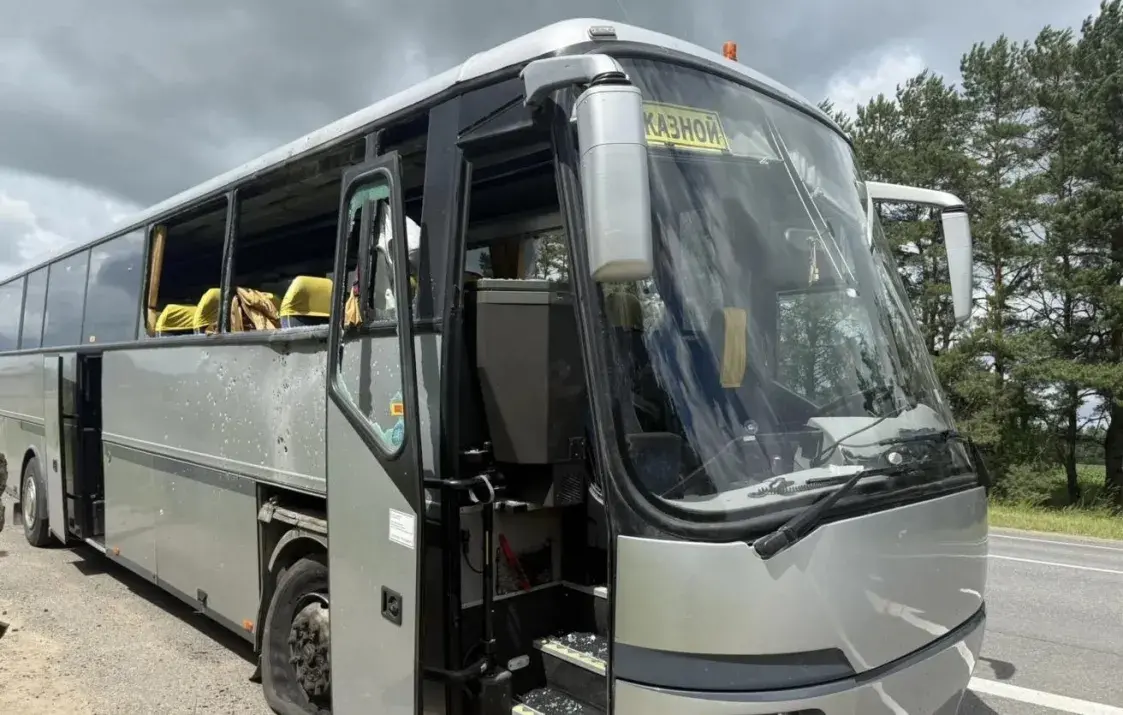
The new attack on July 2, during which two bus drivers and one passenger sustained shrapnel wounds, prompted an even more restrained response from the Belarusian authorities.
The Belarusian Ministry of Foreign Affairs condemned the attack on a civilian object and urged Belarusians and travel companies to exercise greater caution in choosing routes, particularly in border areas and territories associated with military operations.
Alexander Lukashenko this time chose not to comment on the incident. At the time of the attack, he was on an official visit to Myanmar and did not alter his travel schedule.
State Security Council Secretary Alexander Volfovich also refrained from blaming anyone, focusing instead on the need to gather information, coordinate with Russian security forces, and organise assistance for the victims.
Meanwhile, state media once again continued to insult the Ukrainian authorities. The Telegram channel "Yellow Plums," propagandists Ryhor Azaronak and Ihar Tur immediately linked the attack to the Ukrainian leadership and presented it as part of attempts to draw Belarus into the war. However, this time the propaganda focused more on the composure of the Belarusian leadership and Minsk's reluctance to succumb to provocations.
"Seeks to preserve its own room for manoeuvre"
As is evident, state propagandists proved sharper-tongued than Lukashenko and other representatives of the regime.
Media expert of the MediaIQ project Paulyuk Bykouski explains this discord by the fact that state media, in the immediate aftermath of the incidents, did not know how to behave and therefore broadcast belligerent rhetoric.

"In Belarus, there is indeed a very high level of control over state media, but in order to exercise control, one needs to have a clear position on a specific issue.
With the first incident, most likely, the responsible individuals who were supposed to give the media appropriate instructions did not do so immediately. Staying silent was impossible, as the situation had already become known to the public. And the system faced a dilemma.
One option was to say nothing, but that looks abnormal. Another was to repeat the Russian position, since it was already prepared and would definitely not lead to punishment. The third was to develop an independent position, but that is risky, as tomorrow it could become grounds for criticism or punishment.
Therefore, the easiest path for part of the state media was to relay radical statements not in their own name, but through individual authors or bloggers who could appear as people with their own position."
At that moment, state media, according to the interlocutor, were waiting for a signal from the Presidential Administration or the Ministry of Information. Once it became clear that Lukashenko's position was de-escalation, the general tone also began to shift.
"It is also important to understand that in an authoritarian system, the main thing is not for all people to support the leader. The main thing — is for them to remain loyal and not move towards active resistance.
As for the external audience, Lukashenko is also sending certain signals: Belarus does not want war, Belarus does not seek escalation. These signals will be noticed by his international contacts.

At the same time, Lukashenko has long been active in international politics, and everyone understands what to expect from him. So the main thing for him is not to make major mistakes."
Bykouski also believes that since the war, Belarus has lost part of its informational sovereignty. However, a complete merger with the Russian information space has not yet occurred.
"Yes, during the UN Security Council meeting, we saw a difference between the positions of Belarusian and Russian representatives. The Belarusian diplomat was more restrained and did not name specific culprits in the bus incident. The Russian representative, on the contrary, made direct accusations.
A similar situation is observed in Belarusian state media. They often operate within the same information stream as Russian media, but at the same time try not to make direct attacks on Ukraine or Zelensky on behalf of official Minsk."
For this purpose, according to the interlocutor, there are individual authors and propagandists who are permitted more radical rhetoric. They are important to the system, but are not the people who make state decisions.
"Therefore, today we see several things simultaneously: a certain synchronisation with Russia, elements of lost informational sovereignty, and at the same time the preservation of control over the Belarusian information space by the Lukashenko regime.
This is not complete subordination to Moscow. Rather, in certain situations, interests coincide. Belarus can use Russian narratives when it is advantageous to do so, but at the same time seeks to preserve its own room for manoeuvre," — Bykouski believes.